When I started blogging for marketing purposes (to drive traffic and leads to my employer) almost 10 years ago, there weren't many others doing it.
Today, things look very different. According to the Content Marketing Institute, B2B marketers currently allocate 28% of their budget to content marketing. And blogging is a very important component of content marketing. According to the same report, the most successful marketers allocate over 42% of their budget to this purpose, and 76% say that this budget will increase in the coming years.
With such an abundance of content on the internet, it must be really difficult to use your blog today to drive traffic and leads?
No, not at all. My feeling is that it's neither more difficult nor easier. The fundamental principles still apply, and if you follow them, you'll get traffic – just as you always have. For one thing, many more people today search the internet when they have problems they want to solve. But perhaps even more importantly, almost all business blogs are doing it wrong. And that benefits you, who know how to do it right.
The purpose of blogging – to generate traffic and leads
Why do you blog?
If you look at almost any business blog, you will notice that almost no one seems to know why they are blogging in the first place. You can see this in their irregular blogging strategy and in their unfocused content, which doesn't really say anything of importance.
A business-driven blog has two fundamental goals:
Goal 1: Drivenew visits andlead-
Goal 2:Convert existing relationships into business
To achieve these goals, you need to know who you want to attract. Then you need to know why your blog post in particular caught their interest, and what you need to write to get them to want a business relationship with your brand.
But today, almost all business blogs fail at this very thing.
Why almost all business blogs fail to drive traffic and leads
Very few business blogs follow the formula above. Most blogs instead either do so for convenience (e.g., the blog is an easy way to get various news about oneself and one's products out in an unstructured way), or "because one should."
In both cases, the same fundamental mistake is made: you are not blogging for your target audience, but for yourself. The purpose of each blog post is not to solve someone's problem, but to write for your own sake.
And in both cases, they fail to drive visits and leads.
What does it take for a business blog to drive traffic and leads?
First, you need to know the answers to two questions:
- What symptoms do people who would benefit from our solution experience?
- What do we know that these people don't, which makes us see these symptoms in a completely different way than they do?
The answers to these two questions form the foundation of your blogging strategy. Based on the answers, two fundamental types of blog posts emerge: those that drive traffic and those that drive business relationships.
The two fundamental blog types that drive both traffic and business
We can refer to these two types as traffic-driven versus insight-driven blog posts. To be successful, you need both, and you need to use them together in a specific way:
Traffic-driving blog posts – those that attract new visitors
Your visitor-generating blog posts have only one purpose: to attract new potential customersby writing about symptoms they are experiencing. This answers question 1 above. Note that the symptoms you write about do not need to be directly related to your solutions. It is enough that customers searching for them would most likely benefit from your solution.
With an awareness of the symptoms you want to write about, conduct keyword research to find specific search terms that would be used to solve these problems (I will cover this in another blog post). Understand the intent behind these keywords and write keyword-optimized blog posts that satisfy these intents.
If you follow this formula regularly (1-2 times a week) for at least 3, but preferably 6+ months, you will get visitors. Not only that, but the number of visitors will continue to increase for several years after you stop writing.
But to ensure that these visitors don't just solve their immediate problem and then leave, you need to incorporate these blog posts into your insight-driven blog posts, which we'll cover next.
Insight-driven blog posts – the ones that convert your visitors into loyal followers
You know something your customers don't. Customers see their perceived symptoms as an isolated problem they want to solve. You see it in a completely different way: as a minor side effect stemming from a much larger underlying cause. It's time to show your customers this perspective.
Separating your insights from the need to drive traffic is smart marketing: it separates what you really need to say from the need to write about what customers are searching for. Instead, you drive traffic to your insight-driven blog posts by linking from traffic-driving blog posts. This way, you can drive both high traffic and deep insights without having to compromise on either.
What do you do with the visitors that the blog attracts?
Marketing, together with sales, drives customers forward through the buying journey. Through your traffic-driving and insight-driven blog posts, you have taken the first step in that journey.
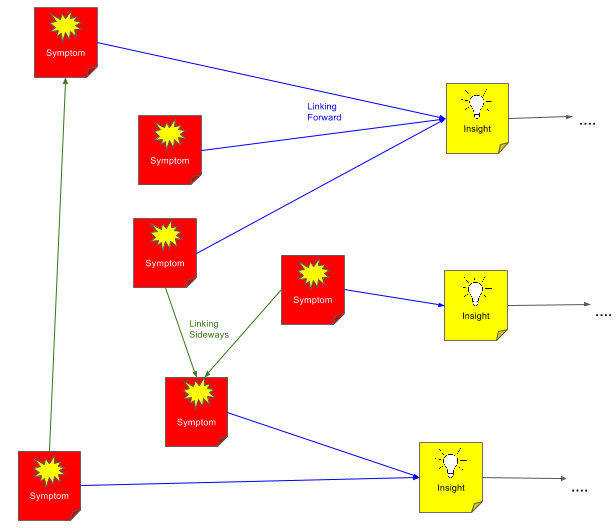
You can now link both "sideways" and "forward" in your blog posts to allow customers to choose the path that is most relevant to them.
Linking to the side means linking to other subject areas. This helps the customer find even more relevant problems that may not have come up in the search. And by linking "forward," you help the customer move forward in their mental journey. The whole picture then looks like this:
Once you have created blog posts that drive both visitors and insights, it is time to naturally incorporate them into an automated purchasing process. We will discuss how to do this in upcoming blog posts.